
This Docker image is managed and kept up to date by epicsoft LLC.
A sign-in gate for websites behind a reverse proxy. Visitors sign in with a one-time code sent by email or with an OpenID Connect provider such as Zitadel; who may enter which host is one list of groups in the configuration. Pages and mails come in German, English, Russian and Georgian, in a neutral look or with the name, mark, logo, colours and texts of the configuration.
- Base image:
scratch— a static Go binary built withgolang:1.27.4-alpine, platformslinux/amd64andlinux/arm64 - Dockerfile: https://gitlab.com/epicsoft-networks/gatekeeper/-/blob/main/Dockerfile
- Repository: https://gitlab.com/epicsoft-networks/gatekeeper, mirrored to GitHub — code changes only as merge requests on GitLab, the mirror cannot take pull requests
- Container registry: https://gitlab.com/epicsoft-networks/gatekeeper/container_registry
- Docker Hub: https://hub.docker.com/r/epicsoft/gatekeeper
- Changelog: https://gitlab.com/epicsoft-networks/gatekeeper/-/blob/main/CHANGELOG.md
- License: MIT
8080 | all endpoints under /_gatekeeper/ — reachable only for the reverse proxy, never published |
127.0.0.1:8081 | health check inside the container (gatekeeper healthcheck) |
/etc/gatekeeper/config.json | the configuration, read-only; secrets in separate files |
Features
- Two ways in, offered per host: a one-time code by email and any OpenID Connect provider (Zitadel, Google, Microsoft, GitLab …) — one list of groups decides for all of them
- Works with nginx
auth_requestand with TraefikforwardAuth, so it protects static sites as well as any service behind Traefik - Pages and mails in German, English, Russian and Georgian; the language follows the browser or the language links
- Branding in the configuration: name, footer link, mark, mail logo, colours and any text - without it a neutral look
- Optional ALTCHA proof of work before the code by email, checked at the ALTCHA service: a bot never sees the address field
- Optional bounce handling: no code mail for 48 hours to an address whose code mail bounced
- IP lists: addresses and networks let in without signing in, or kept out — IPv4 and IPv6
- Access is checked on every request against the current configuration — removing an address or a sign-in method locks out at once
- No database and no volume: sessions are encrypted cookies, pending codes and rate limits live in memory, users and groups come from the configuration
- Optional counting of the sign-in page and its steps in Umami, respecting Do Not Track and GPC per host
- One static binary without shell or packages: a 15 MB image, about 5 MiB of memory at rest
Screenshots
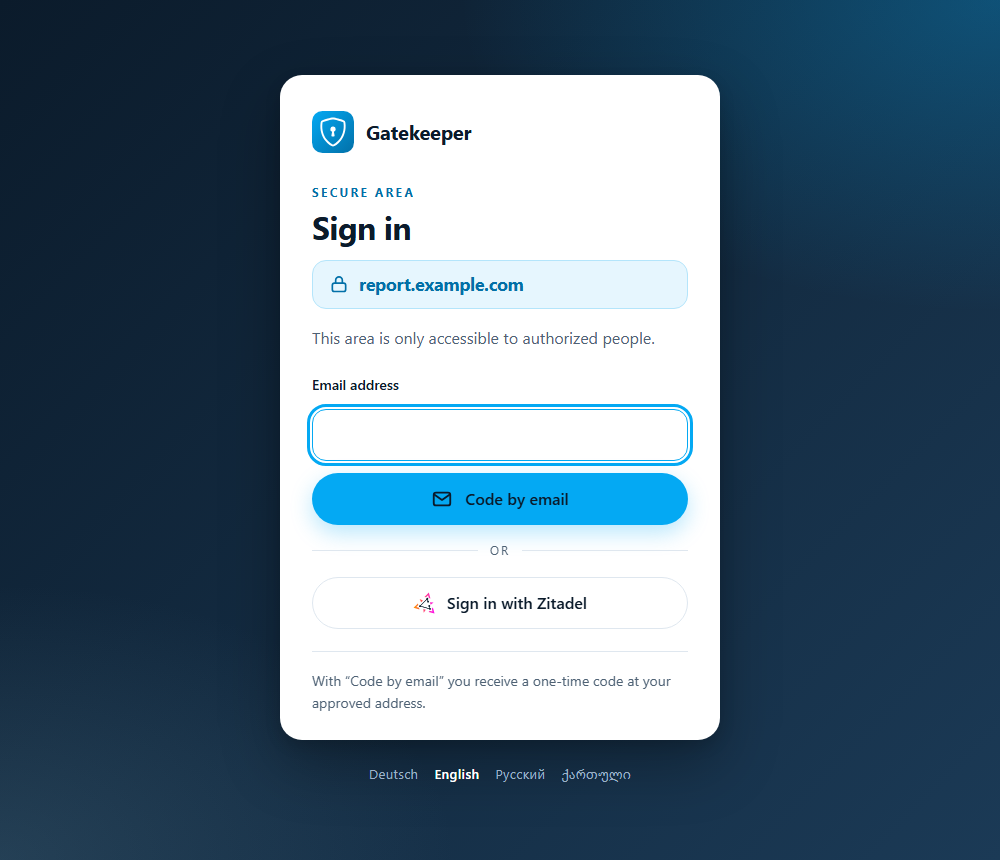
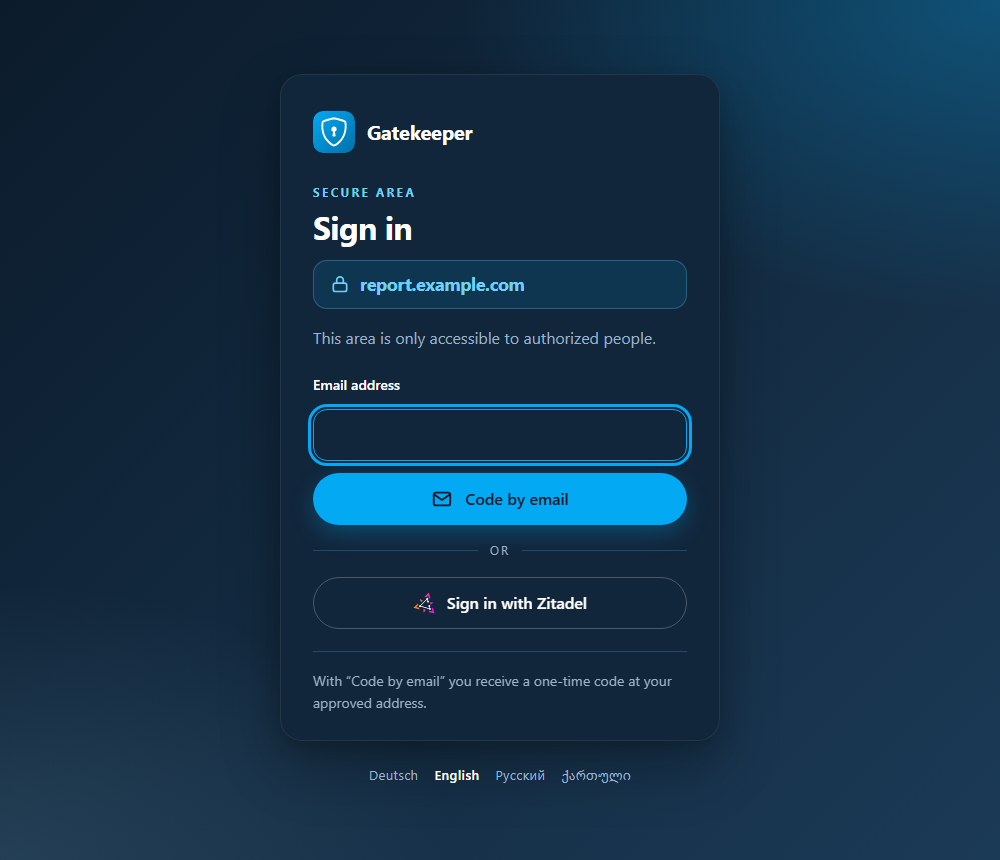
The sign-in page, light and dark - language and colour scheme follow the browser:
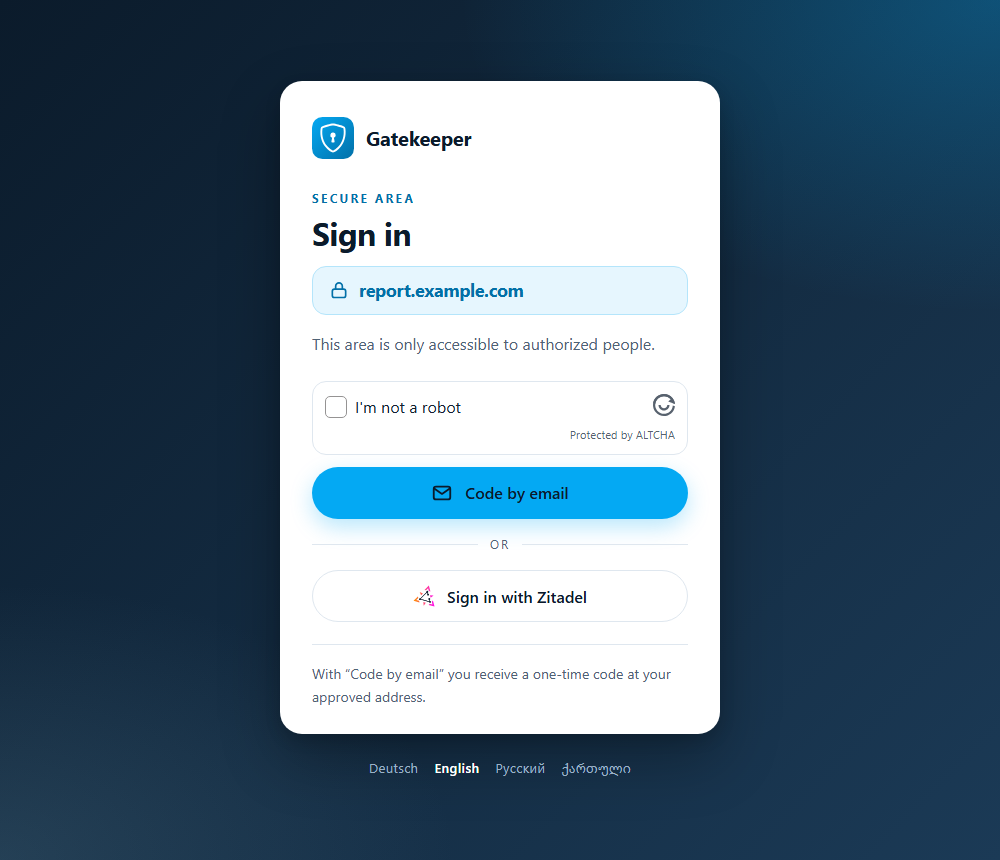
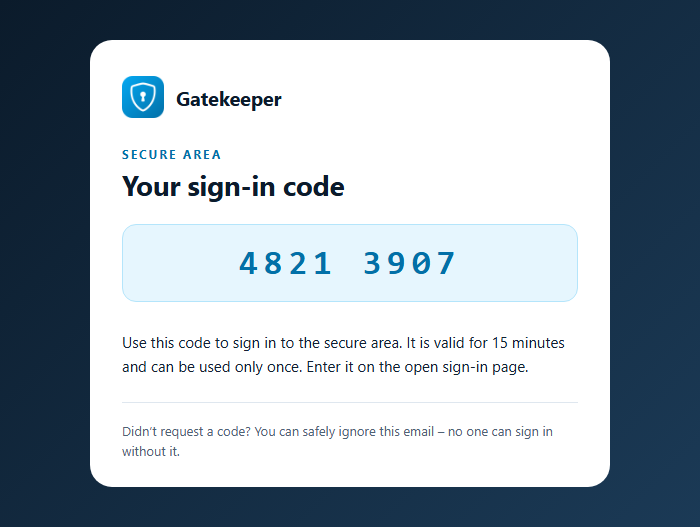
With altcha the code by email starts with the widget, and the code mail:
How it works
browser ──▶ reverse proxy ──auth──▶ gatekeeper  /_gatekeeper/auth: 202 · 401 · 403
               │   401 ──────────▶ /_gatekeeper/sign_in   sign-in page at the protected address
               │   403 ──────────▶ /_gatekeeper/denied    "signed in as …, no access"
               │
└── /_gatekeeper/* ──▶ gatekeeper forms, code entry, provider start and callback, sign-out- The proxy asks
/_gatekeeper/authon every request. Without a session the visitor sees the sign-in page at the address they asked for. - Code by email: the visitor enters an address (with
altchaafter a proof of work) and gets the same answer whether it has access or not. Only an address with access receives a mail with an eight-digit code; the code works only in the browser that asked for it, for fifteen minutes and five attempts. - Provider: the visitor is sent to the provider with state, nonce and PKCE; the callback accepts only a token that go-oidc has verified and an address the provider marks as verified.
- Either way the address must be in a group the host allows. The session is an encrypted cookie bound to the host.
Quick start
services:
  gatekeeper:
    image: epicsoft/gatekeeper:X.Y.Z
    container_name: gatekeeper
    restart: always
    read_only: true
    cap_drop: [ALL]
    security_opt: ["no-new-privileges:true"]
    volumes:
      - ./config.json:/etc/gatekeeper/config.json:ro
      - ./secrets/gatekeeper_secret:/run/secrets/gatekeeper_secret:ro
      - ./secrets/gatekeeper_smtp_password:/run/secrets/gatekeeper_smtp_password:ro
      - ./secrets/gatekeeper_zitadel_secret:/run/secrets/gatekeeper_zitadel_secret:ro
    networks: [proxy]
    deploy:
      resources:
        limits: {cpus: "0.25", memory: 64M}

networks:
  proxy:
    external: true
The image runs as uid 65532; the secret files must be readable for it. Create the session secret with openssl rand -base64 48.
Check a configuration before a restart: docker run --rm -v ./config.json:/etc/gatekeeper/config.json:ro … gatekeeper check — it reads the secret files too and lists every problem at once.
Configuration
A JSON file; an unknown key stops the start. A complete example: examples/config.json.
| Key | Default | Meaning |
|---|---|---|
secret_file | — | file with at least 32 bytes; every cookie key is derived from it. A new secret ends all sessions |
trusted_proxies | — | addresses or networks whose X-Forwarded-* headers are believed, see Trusted proxies. Required; 0.0.0.0/0 and ::/0 are refused |
client_ip_header | X-Real-Ip | header with the visitor’s address from a trusted proxy |
default_language | en | de, en, ru or ka — when the browser asks for none of them |
session | 24h | lifetime of a session, 5m to 720h |
listen / health_listen | :8080 / 127.0.0.1:8081 | addresses of the two listeners |
groups | — | group name → list of addresses, lower case, or whole domains as @example.com (exactly that domain, not its subdomains; local parts of letters, digits, ., _, +, - only). They decide for the code by email and for providers without groups_claim |
hosts | — | host name → login (methods in the order of the page: email or provider ids), allow (group names), optional session, ip_allow and ip_deny. The entry * applies to every host without one; without it an unknown host is refused |
ip_allow / ip_deny | — | addresses and networks, IPv4 and IPv6 (203.0.113.7, 2001:db8::/48), for every host or in a host entry. ip_allow lets a client in without signing in and without X-Gatekeeper-User; ip_deny gives it 403 on every path, sign-in and code mail included, and wins. /0 is refused in ip_allow; without a client address from the proxy neither list applies |
providers[] | — | id, name (on the button), icon (zitadel or empty), issuer (https), client_id, client_secret_file (empty for a public client with PKCE), scopes (default openid email profile), logout, groups_claim |
providers[].groups_claim | empty | claim with the groups of the account at the provider — a list of names, one name, or an object keyed by name (the role claims of Zitadel). With it, the provider’s groups decide against the host’s allow, not the addresses in groups, and allow may name groups that only the provider knows |
providers[].logout | empty | backend ends the provider session with a server-side call, browser sends the visitor to the provider’s end-session page, empty ends only the gatekeeper session |
mail | — | required as soon as a host offers email |
mail.host / port / tls | — / 587 / starttls | starttls, tls (implicit) or none; with a user name only starttls or tls |
mail.server_name | mail.host | name the server certificate must carry |
mail.username / password_file | — | submission account |
mail.from / from_name | — | sender of the code mails |
mail.code_ttl / code_attempts | 15m / 5 | lifetime of a code (whole minutes, 1–60) and wrong entries before it is void |
mail.link | false | a sign-in button in the code mail, see Security; the mail then names the host |
mail.limits | see example | per_client (code requests and ALTCHA checks per client address; a whole IPv6 /48 gets 16 times the count), per_address (per entered address), total (mails of the instance; addresses that get in only through a domain entry use at most half of it), attempts (code entries per client); each {count, window} |
mail.bounces | — | stops mail to an address whose code mail bounced, see Bounces. Needs mail.username |
mail.bounces.imap_host / imap_port | mail.host / 993 | IMAP with TLS from the first byte; the certificate must carry mail.server_name on mail.host, else imap_host |
mail.bounces.poll / suppress | 1m / 48h | how often the mailbox is read (10s to 1h) and how long a bounced address gets no mail (1h to 720h) |
mail.bounces.delete_others | false | also delete every other mail in the mailbox - for an account nobody reads |
umami | — | url of /api/send, website id, respect_opt_out (hosts on which Do Not Track and GPC stop the counting) |
altcha | — | url of the ALTCHA service (https) and its site, see ALTCHA |
branding | neutral | name, owner, url, mark_file, logo_file, colors, texts_file, see Branding |
Client addresses are limited per IPv4 address and per IPv6 /64. The configuration is read once at start; a change needs a restart.
Trusted proxies
Whatever is in trusted_proxies can choose the host and the client address of a request - with ip_allow its way in, too. Keep it narrow: the proxy container, or the Docker network gatekeeper shares with the proxy (docker network inspect <network> shows its subnet). Of X-Forwarded-Host, X-Forwarded-Uri and client_ip_header gatekeeper takes what the nearest proxy wrote, the last entry of the last line. A request whose Host names one configured host and whose X-Forwarded-Host another is refused - a proxy that passes the client’s X-Forwarded-Host through would otherwise let a session of one host open another.
Branding
Without branding the pages and the mail carry a neutral look: the name “Gatekeeper”, a shield on a blue square, no footer line. A mark of mark_file also lies large and faint behind the page.
| Key | Default | Meaning |
|---|---|---|
name | Gatekeeper | next to the mark, in the mail and in the page titles - at most 40 bytes |
owner / url | — | the footer line of pages and mail; url (http or https) makes it a link and needs owner |
mark_file | the shield | an SVG of at most 32 KiB, inlined into every page and used as favicon. Only paths, basic shapes, groups, gradients and clip paths with their presentation attributes pass; anything else - script, style, event handlers, links, images, text, external references - stops the start. A pointer is only url(#id) to an element of the file. The mark is written out anew, never passed on as it came |
logo_file | the shield as PNG | the image of the code mail: a PNG of at most 64 KiB, 16 to 1024 pixels, shown 42 pixels high |
colors | #04a9f3, #0270a8, #6fd0fb | brand (buttons, focus), brand_strong (accents on light), brand_dark (accents in dark mode), each #rrggbb; the text on a button is ink or white, whichever reads better. The default mark keeps its blue |
texts_file | — | JSON like texts.json: per language the texts to replace, see examples/texts.json. Only keys that exist and the placeholders of the original; an unknown key stops the start |
ALTCHA
With altcha the code by email starts with the ALTCHA widget of the ALTCHA service instead of the address field; the providers stay as they are. gatekeeper checks the solution at the service’s POST /verify with its site, server to server, and the service spends it. Only then a sealed cookie opens the address field, once, for ten minutes, for the same client address and host.
- Create a site in the ALTCHA service whose origins are the protected hosts with code by email, and name it in
site. - Fail closed: an unreachable service or a refusal means no code by email, with a message; the providers keep working.
- Only this step has a script: its Content Security Policy admits exactly the widget, exactly the challenge and the widget’s
blob:workers; the widget’s style gets a nonce. The service is trusted - a compromised one could run its own script here. - gatekeeper verifies for all visitors from one address, so
RATE_VERIFY_PER_IPof the service is the ceiling of the step.
Bounces
With mail.bounces every code mail goes out with an envelope sender of its own, <local>+b-<token>@<domain> of mail.from; the From stays mail.from.
- Only real bounces count: a delivery status notification (RFC 3464) that comes back to such an address with a token gatekeeper knows, names the address that token went to and reports a failure (
5.x.x, or4.x.xwith actionfailed). A forged bounce naming someone else’s address does nothing. - gatekeeper reads the inbox of the submission account over IMAP every
poll, deletes the mails to its+b-addresses and leaves other mail alone - unlessdelete_others. - A bounced address gets no mail for
suppress; a code request for it gets the same answer as always, the log sayscode mail suppressed. Tokens wait seven days in memory; a restart forgets them. - The mail server must let the account send with the
+form of its address and deliver plus addresses into its mailbox - a refused envelope sender stops every code mail.
Provider registration
Register one confidential (or PKCE-only) web application per provider with the redirect URI https://<host>/_gatekeeper/callback/<id> for every protected host. With logout: browser also add https://<host>/ as post-logout redirect URI. The provider has to deliver email and email_verified, in the ID token or through userinfo — and, with groups_claim, the groups. In Zitadel these are the roles of the project: either the project setting “assert roles on authentication” (urn:zitadel:iam:org:project:roles) or an action that writes a flat list such as gatekeeper:roles. Name the roles like the groups in allow. Roles changed at the provider take effect with the next sign-in.
nginx
server {
    listen 8080;
    server_name report.example.com;
    resolver 127.0.0.11 valid=30s ipv6=off;
    set $gatekeeper gatekeeper:8080;

    location = /_gatekeeper/auth {
        internal;
        proxy_pass http://$gatekeeper;
        proxy_pass_request_body off;
        proxy_set_header Content-Length "";
        proxy_set_header Host $host;
        proxy_set_header X-Forwarded-Host $host;
        proxy_set_header X-Forwarded-Proto https;
        proxy_set_header X-Forwarded-Uri $request_uri;
    }

    location ^~ /_gatekeeper/ {
        proxy_pass http://$gatekeeper;
        proxy_set_header Host $host;
        proxy_set_header X-Forwarded-Host $host;
        proxy_set_header X-Forwarded-Proto https;
        proxy_set_header X-Forwarded-Uri $request_uri;
    }

    location / {
        auth_request /_gatekeeper/auth;
        error_page 401 = /_gatekeeper/sign_in;
        error_page 403 = /_gatekeeper/denied;
        expires -1;
        try_files $uri $uri/ =404;
    }
}
X-Forwarded-Uri $request_uri is required: after error_page nginx no longer knows the query, the gatekeeper takes the way back from this header. expires -1 makes the browser ask again after signing out. The client address is the X-Real-Ip of a Traefik in front, passed on by nginx.
Traefik
services:
  app:
    labels:
      - traefik.http.routers.app.rule=Host(`app.example.com`)
      - traefik.http.routers.app.middlewares=gatekeeper@docker
      - traefik.http.middlewares.gatekeeper.forwardauth.address=http://gatekeeper:8080/_gatekeeper/forward_auth
      - traefik.http.middlewares.gatekeeper.forwardauth.authResponseHeaders=X-Gatekeeper-User
  gatekeeper:
    labels:
      - traefik.enable=true
      - traefik.http.routers.gatekeeper.rule=Host(`app.example.com`) && PathPrefix(`/_gatekeeper/`)
      - traefik.http.routers.gatekeeper.priority=1000
      - traefik.http.services.gatekeeper.loadbalancer.server.port=8080
/_gatekeeper/forward_auth answers with the whole sign-in page, because Traefik passes the answer of a refusal on to the browser. The router for /_gatekeeper/ must not carry the middleware. trusted_proxies has to contain Traefik’s address in the Docker network.
Endpoints
| Path | Method | Purpose |
|---|---|---|
/_gatekeeper/auth | any | for nginx auth_request: 202 with X-Gatekeeper-User (without for ip_allow), 401 without session, 403 without access, for an unknown host or ip_deny |
/_gatekeeper/forward_auth | any | for Traefik forwardAuth: 200 with X-Gatekeeper-User, otherwise 401/403 with the page |
/_gatekeeper/sign_in | GET | sign-in page (status 401) |
/_gatekeeper/denied | GET | “signed in, no access” (status 403) |
/_gatekeeper/altcha | POST | checks the ALTCHA solution and opens the address field |
/_gatekeeper/email | POST | requests a code |
/_gatekeeper/code | GET, POST | code entry; GET with t: the button of mail.link |
/_gatekeeper/start/<id> | GET | sends the visitor to provider <id> |
/_gatekeeper/callback/<id> | GET | return from the provider |
/_gatekeeper/sign_out | GET | a page with the sign-out button - link here from the protected site |
/_gatekeeper/sign_out | POST | ends the session (and the provider session as configured), then / |
Security
- Fail closed. An unknown host, a cookie that does not open, an expired flow or any provider error ends in the sign-in page or a refusal — never in access.
- Sessions are AES-256-GCM encrypted cookies (
__Host-gatekeeper,Secure,HttpOnly,SameSite=Lax), bound to the host they were issued for. Each cookie purpose has its own key, derived fromsecret_filewith HKDF. - Codes are eight digits from
crypto/rand, kept only as HMAC, bound to a cookie of the requesting browser and to the host, valid forcode_ttl, void aftercode_attemptswrong entries or after use. A new code for the same address and host voids the previous one. - The button of
mail.linksigns in only the browser that asked for the code, by a token of its own, so a wrong one costs no attempt. The code’s cookie isSameSite=Laxthen, so a click in webmail carries it. - No hints about addresses. An address without access gets the same answer, the same cookie and the same code page as one with access; the per-address limit applies to every address. The mail goes out in the background, so the answer takes the same time.
- Mail goes only to the normalized address - one of the configuration, or one at a domain entry’s exact domain with a plain local part - never to the raw input. Addresses are plain ASCII, checked before lower case. Without STARTTLS (or with a certificate for another name) no password and no mail leave the service.
- Providers: state, nonce and PKCE (S256); go-oidc checks signature, issuer, audience and expiry; the address must be marked verified, address and verification come from the same document; userinfo must belong to the same subject.
- Forms carry a CSRF token bound to a cookie and the host; cross-origin posts are refused on top (
Sec-Fetch-Site,Origin). Signing out is such a form: aGETonly shows the button, so a foreign page cannot sign anybody out. - Way back after signing in only to a path on the same host — never
//, a scheme, a backslash or the gatekeeper’s own paths. - Pages have a strict Content Security Policy without scripts (
default-src 'none', the one style element by hash),X-Frame-Options: DENY,no-store,noindex- except the ALTCHA step. The mark passes an allowlist, colours are only#rrggbb.
Decided on purpose:
- A code is as safe as the mailbox. Whoever reads the mail of an address with access can sign in for it.
- Foreign code requests can lock out an address for a while: the per-address limit counts every request for it, whoever makes it - otherwise a flood could mail one inbox without end.
- Sessions live only in the cookie. Signing out removes the cookies of this browser; a copied session cookie stays valid until
sessionends. Removing the address or the method in the configuration ends it at once. groups_claimtrusts the provider’s group names - use it only with a provider whose groups the users cannot create or join themselves.X-Gatekeeper-Usercarries the address only, not the provider.- Umami counts only when configured, and on the hosts in
respect_opt_outnot for Do Not Track and GPC.
What is stored and logged
| Content | Kept | |
|---|---|---|
| Browser | session cookie (address, method, time of sign-in, the provider’s ID token for the logout), cookies for a pending code, a provider sign-in, a solved ALTCHA and the CSRF token | session until session ends or sign-out, the others minutes to a day |
| Memory | pending codes and their link tokens as HMAC with address and host, rate limit counters, spent ALTCHA tickets; with mail.bounces the token of every code mail with its address and the addresses that bounced | until expiry; tokens seven days, bounced addresses suppress |
| the code, sent to the address with access | not stored by the service | |
| Umami (optional) | sign-in page view and steps with host, path, referrer, browser language, client address and user agent | as kept by Umami |
| Log | sign-ins and sign-outs with host, method and address; provider sign-ins without access with the address the provider verified; code requests with host (the address only if it has access); used-up codes, rate limits, mail, provider and ALTCHA errors; bounced and suppressed code mails with the address | as long as the container log is kept |
Client addresses, codes, tokens and cookies never reach the log.
Commands
| Command | |
|---|---|
gatekeeper / gatekeeper serve | runs the service; -config or GATEKEEPER_CONFIG names the file |
gatekeeper check | checks the configuration and its files, exit code 1 with the list of problems |
gatekeeper healthcheck | -addr of the health listener, used by the image’s HEALTHCHECK |
gatekeeper version | the version the image was built as |
Versions
| Tag | |
|---|---|
X.Y.Z | a release from the git tag — the only tag a deployment should pin |
X.Y, X | the newest release of that line |
latest | branch main and the newest release |
develop | branch develop, GitLab registry only |
Reporting problems
Issues are welcome on GitLab and GitHub; a security problem as a confidential issue on GitLab, see SECURITY.md.
License
MIT — Copyright (c) 2026 epicsoft LLC / Alexander Schwarz
Third-party software in the image — Go, github.com/coreos/go-oidc, github.com/go-jose/go-jose, golang.org/x/oauth2, the icon shield-lock of Bootstrap Icons in the default mark (MIT) and the CA certificates of Alpine — remains under its own licenses.